
World Cup numbers are eye-watering in the land of the fee

‘As featured in the Sunday Independent’

Kevin Moore, Legacy Communications


The 2026 Fifa World Cup group games have come and gone, and the knockout stage is into the last-16 phase. The pre-tournament socio-political discourse gave way to matters on the pitch, and we have been treated to a great opening act.

We are now entering the real business end of this global sporting phenomenon.

While the Olympics may top the charts in terms of pure scale, the Fifa World Cup is unrivalled when it comes to a money-making machine.

With the mighty United States of America playing the lead host nation, it’s hard not to feel the commercial aspect of the event seeping through via every corner.

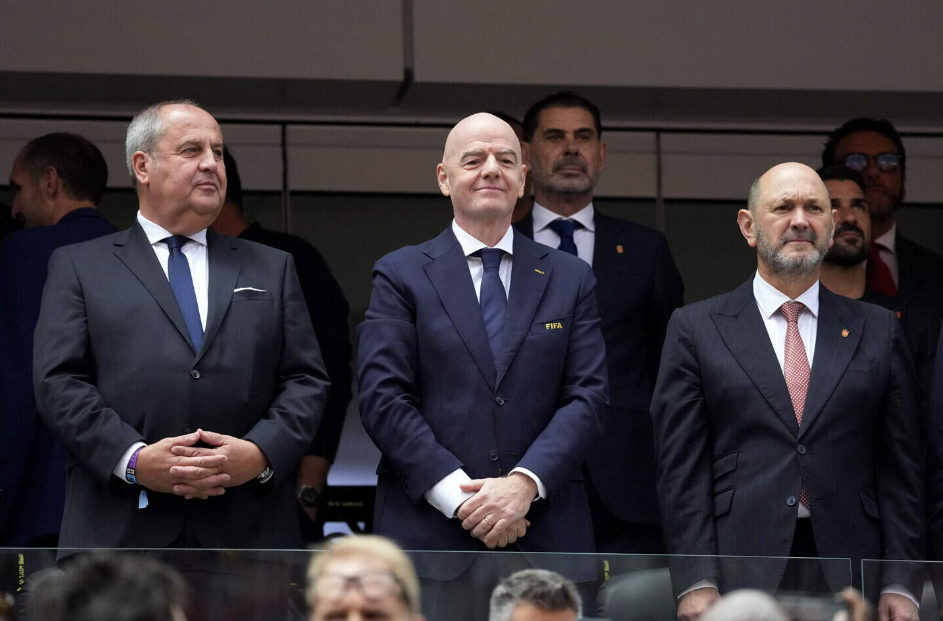
Austrian FA president Josef Proll, Fifa president Gianni Infantino and Spain FA president Rafael Louzan  © Kirby Lee/Reuters

As an overall revenue spinner, the Fifa World Cup four-year cycle (2023-2026), is predicted to generate up to $13 billion in revenue, a reported 70 per cent increase over the previous World Cup in Qatar.

It is therefore no surprise that this year’s World Cup is on course to be Fifa’s most profitable ever. The increase in revenue can be largely attributed to two factors: the expanded format along with commercial opportunism.

The 2026 World Cup has expanded from 32 to 48 teams, and the impact has been clear from both a sporting and commercial perspective. The 16 additional countries have lifted the event to a whole new level of fandom, while the 40 additional matches have created far more ticket inventory, television content, and sponsorship opportunities than previous World Cups.

American business tycoon Warren Buffet once said: “The plan itself is opportunism. There is no plan before that.”

The combination of staging football’s showpiece event in the land of opportunity was always going to result in every commercial opportunity being leveraged. One of the primary examples of this opportunism has been the hydration break.


‘Traditionally a game of two halves, this has a feel much more akin to American sporting experience of four quarters’ 


The player welfare concern of staging the tournament mid-summer in Mexico, Canada and the US, where temperatures can soar, is valid. But with varying match times and many air-conditioned stadiums, the decision to introduce three-minute mandatory hydration breaks in every half of every game has all the hallmarks of commercial intent as much as player welfare.

It has created one of the most valuable extra advertising and sponsorship windows in sport, which has no doubt had a huge impact on the additional revenue for the tournament and host broadcasters.

In the US, Fox Sports have been cutting away to full-screen commercials, garnering large amounts of advertising revenue. Closer to home, ITV in the UK chose not to show commercials during the hydration break; however, this is mainly due to Ofcom regulations rather than football purism. Our own home broadcaster, RTÉ, landed somewhere in the middle, confirming they would carry adverts during some hydration breaks in the high-profile matches.

The consequence of the much talked about hydration breaks has impacted the on-pitch spectacle. Traditionally a game of two halves, this has a feel much more akin to American sporting experience of four quarters. Fans and pundits have been out in force commenting on how it has killed or shifted momentum in many games.

Ticket prices have been another huge talking point surrounding the tournament. Fears were that dynamic pricing and pure commercialism would completely price out fans and attendance would suffer or competing nations fans would be replaced by those from the host country.

Fifa president Gianni Infantino argued that price setting is linked to the host nation’s market and that too many low-priced tickets would mean a flood of black-market activity. Both arguments have some merit, but the estimated increase in 2026 average ticket price of over 100 per cent from Qatar is hard for many fans to stomach.

Some 130,000 of the 1.1 million stadium seats were available for as low as $60, but the range in ticket prices as the tournament progresses rises to spectacular heights. Knockout stage games will regularly cost $1,000 per ticket, while premium seats will sell for several thousand per match, with some tickets for the World Cup final likely to exceed €10,000.

The American premium sports-ticket market is simply like no other. The recent NBA Basketball finals between New York Knicks and the San Antonio Spurs saw upper seats sell for $5,000, while ring-side seats reached $75,000.

The numbers so far are clear, and fans have turned up in record numbers. Since the very first group game, stadiums have averaged 99.6 per cent capacity, with approximately 4.6 million spectators attending the group stage — setting a new World Cup record.

And from the outside looking in, it does seem like the stadiums are filled with a vast number of genuine fans, experiencing a once-in-a-lifetime event in the very best sporting venues on the planet.

Every aspect of the American stadiums seems bigger and better, with the Los Angeles SoFi Stadium home to the world’s largest sports screen, at 70,000 square feet. To put this in perspective, their Infinity Screen is larger than a standard Fifa football pitch.

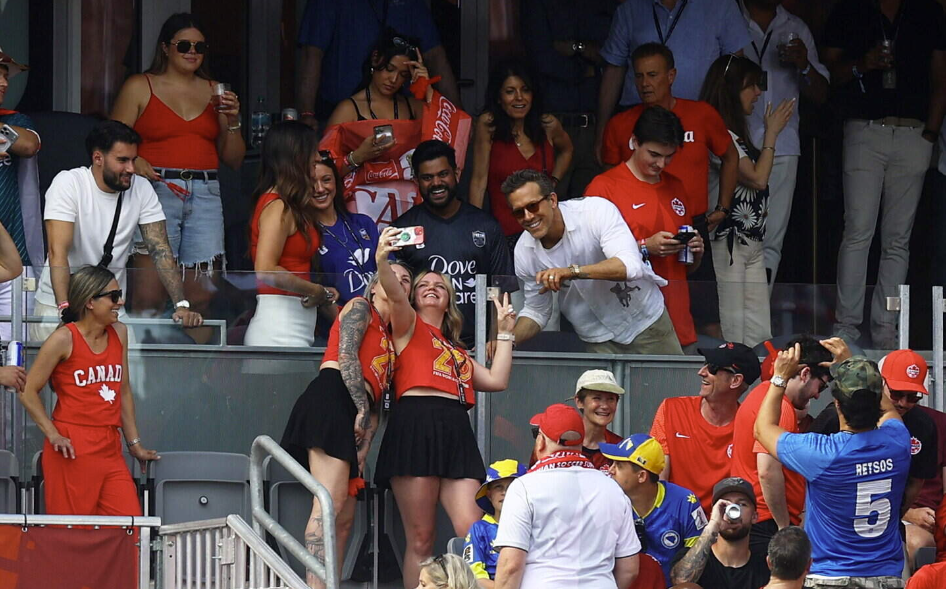
Ryan Reynolds poses for a selfie with Canadian fans  © Claudia Greco/Reuters

Camera operators have used the giant screens to showcase the many A-list celebrities supporting their teams. Salma Hayek, Brad Pitt and Ryan Reynolds among many others from the host nations of Mexico, US and Canada that have been spotlighted.

After bringing Lionel Messi to his American football club, Inter Miami, David Beckham’s stock seems to have risen to the very top echelon of celebrity status. He has featured in several high-profile campaigns surrounding the World Cup, reflecting his stature as one of football’s most marketable ambassadors. Adidas, Lenovo, Nespresso and Bank of America have all used Beckham to front campaigns.

It is not only past players who are cashing in. The World Cup provides the largest shop window in football for players to impress. A good run and some standout individual performances can drastically increase a player’s market value, particularly for emerging or young players.

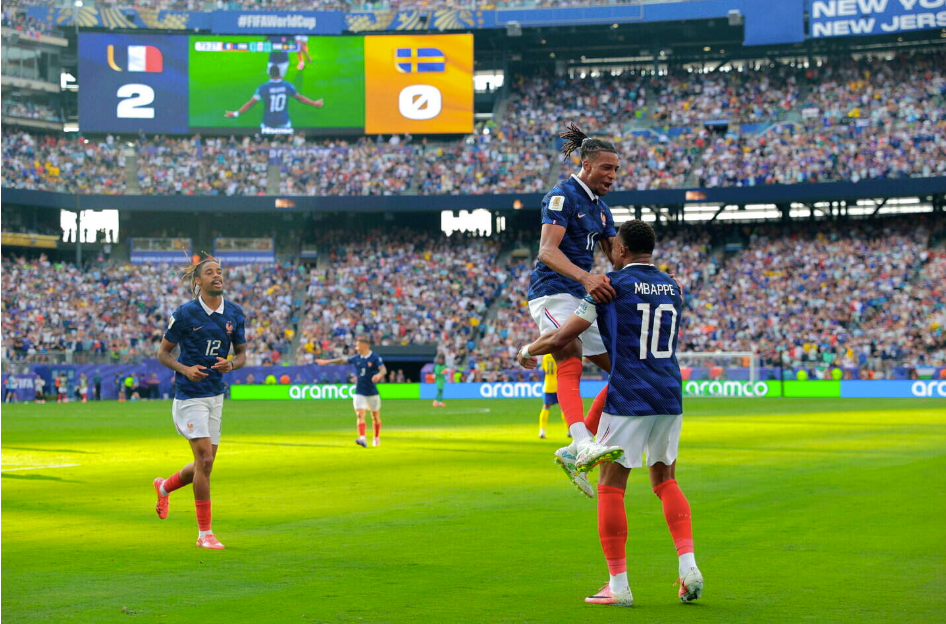
France’s Kylian Mbappe celebrates scoring their third goal with Michael Olise during their tie against Sweden  © Pamela Smith/AP

France’s Michael Olise’s stock continues to rise match after match, while Morocco’s 18-year-old midfielder, Ayyoub Bouaddi, who plays his club football for Lille in France, will now be on the radar of all the world’s top clubs.

Watch out for the recipient of the Young Player of the Tournament award this year. Shortly after winning the accolade at the 2022 Fifa World Cup, Enzo Fernandez benefited from a €120 million transfer to Chelsea.

The World Cup final will be played on 19 July in what is usually known as the MetLife Stadium in New Jersey in front of 82,500 fans and beamed to an estimated global audience of over 1.5 billion people.

The final act of the global sports phenomenon will include one final cultural and commercial addition to the biggest match in sport, a half-time show similar to the Super Bowl.

The pairing of the US market with the Fifa machine has created a commercial crescendo that may reach peak status. Although record television audiences are likely to increase the value of Fifa’s future broadcast rights, meaning the only way is up.

Fifa will rightly point to how their revenue is reinvested in football nations, both big and small, all over the world, but the extraordinary amount of revenue associated with the event showcases just how commercial it has become.

The Most World Cup Obsessed Counties

It’s nearly here. World Cup 2026 kicks off in the United States, Canada and Mexico. There are 48 teams, 104 matches and six weeks of football, all the way up to the final on 19 July. 

Ireland fought back brilliantly to reach the playoffs, then lost to Czechia on penalties back in March. Now it’s at least another four years before we get a shot at the World Cup. Every Irish football fan knows how much that one hurt. 

Heartbreak aside, it hasn’t stopped us caring one bit. We looked at the search numbers, and Ireland is still mad about the World Cup. 


How we worked it out 

We pulled average monthly Google search volumes for the World Cup terms everyone’s typing in right now (things like “FIFA World Cup”“World Cup 2026”“how to watch World Cup 2026” and “World Cup live stream 2026”) for every county in Ireland. 

To keep it fair, we measured searches per 100,000 people. That levels the playing field and shows where the obsession really runs deepest, head for head. 


The top 10 most World Cup-obsessed counties  

  1. Dublin (1,773 searches)  
  2. Wexford (1,525 searches) 
  3. Louth (902 searches) 
  4. Kildare (896 searches) 
  5. Westmeath (852 searches) 
  6. Cork (837 searches) 
  7. Carlow (823 searches) 
  8. Wicklow (802 searches) 
  9. Waterford (793 searches) 
  10. Galway (792 searches) 

Dublin is Ireland’s most World Cup-obsessed county, with a whopping 1,773 searches per 100,000 people. Wexford ranks in second place with 1,525 searches per 100,000, punching miles above its weight and out-searching much larger counties like Cork, Galway and Limerick on a per-head basis. If anyone tells you Wexford is all hurling, point them to this table. 

Louth (902), Kildare (896) and Westmeath (852) complete the top five. 

Cork lands in sixth on 837 searches per 100,000 people. As the biggest county outside the capital, Cork actually racks up the second-highest raw search volume in the country at 4,890, but once you measure it per head, it slips to sixth, proof that sheer size doesn’t equal the deepest obsession. Just behind comes Carlow in seventh (823), one of the smallest counties on the list yet more World Cup-mad per person than counties many times its size. Wicklow takes eighth place with 802 searches per 100,000 people, keeping Leinster well represented at the top. 

Completing the top ten are two counties carrying the flag for the south and west. Waterford sits ninth on 793, the second Munster County to make the cut after Cork and a reminder that the appetite for the World Cup is alive and well.  

And in tenth, on 792, is Galway, the only Connacht County to break into the top ten and comfortably the province’s most World Cup-obsessed. Leinster runs the show, with seven of the top ten, but the truth is that every county in the country is still searching, still planning and buzzing for the games to begin. 

Mary McGuire, Head of Sponsorship at Legacy Communications commented: Even after Ireland’s playoff heartbreak, the World Cup still has a huge emotional pull here in Ireland. From Dublin’s sheer volume to standout interest in places like Wexford and Carlow, fans across the country are gearing up for kick-off in their own way; whether that’s 4am watch parties or just keeping up with the drama. It really shows that for Irish fans, the World Cup isn’t only about who’s playing, it’s about being part of a global sporting moment.”

Happy Christmas to all of our clients! (SCROLL DOWN AND CLICK PLAY)

A Christmas message, from Legacy Communications:

This year, we chose to do something a little different.

Instead of sending Christmas gifts, we have donated €2,500 to five charities that are doing vital work across Ireland and beyond. It is our way of saying thank you to our clients, our partners, and the communities we are proud to be part of.

The video below is our Christmas card to you.

It is a short message of thanks, and a small reflection on why these causes matter to us.

The Charities We Are Supporting

This Christmas, our donation has been shared equally between:

  • Pieta
    Providing free, professional support to people impacted by suicide and self-harm.

  • Movember
    Supporting men’s mental health and funding research into cancer and suicide prevention.

  • Liberty Soup Run
    Delivering food, clothing, and human connection to people experiencing homelessness in Dublin.

  • Barnardos
    Supporting vulnerable children and families across Ireland.

  • Dogs Trust
    Caring for abandoned and neglected dogs and promoting responsible dog ownership.

We are grateful for the trust our clients place in us every day. Your support allows us to give back in meaningful ways.

From all of us at Legacy Communications, we wish you a peaceful Christmas and a positive start to the year ahead.

Building A Legacy: Season 2

Following the success of the first three instalments, which explored Legacy’s growth story, the importance of creativity, and the evolving role of sponsorship, the new episodes turn their focus to two of the most urgent shifts shaping marketing today: the AI-driven transformation of search, and the fusion of PR and content into an omni-channel newsroom.

Episode 4: AI & The Evolution Of Search

For over two decades, “just Google it” was the cultural reflex. Now that default is being disrupted. Legacy’s Mícheál Brennan, Head of Search & Digital PR, and James Elms, Head of Corporate PR, join Gus Pelogia, Senior SEO & AI Product Manager at Indeed, to explore how discovery is splintering across AI chatbots, TikTok, Reddit and YouTube, and how Google is fighting back with conversational search.

Brennan explains why SEO is shifting into “search everywhere optimisation,” Elms highlights PR’s growing role as the engine of credibility, and Pelogia offers a global perspective on how brands are preparing for a new era where visibility and trust must work hand in hand.


Episode 5: The Evolution of Content – The Brand Newsroom

If Episode 4 looks at how audiences find information, Episode 5 examines how brands tell their stories. Niamh Hopkins, Head of Consumer PR at Legacy, Shireen McDonagh, Head of Brand & Content at Legacy, and Pippa Doyle, Senior Manager of Global PR at WHOOP, reveal how PR and content have merged into one integrated discipline.

Together, they argue that the most effective brands now act like newsrooms: agile, creative, always-on, and built to spark culture-driven conversations.


E-commerce SEO: 5 Lessons the USA and Emerging Markets Can Teach Us

If you’re running or working in an e-commerce business, you’re probably all about getting more traffic and increasing sales through organic search. With SEO, you can target a wider range of keywords (since PPC usually focuses on high-intent, commercial terms) and even beat bigger players with equally bigger paid ad budgets  

This guide breaks down some of the basics of e-commerce SEO Product Detail Pages while sprinkling in some fresh, standout tips inspired by examples from the USA and emerging markets. These insights can help you get a solid edge over your competition. 


Well, a little context on Product Detail Pages (PDPs) first 

Google SERPs with an e-commerce intent are increasingly moving away from the traditional “blue links” results. Sponsored Shopping Ads and Organic Product Listings are becoming dominant, particularly in the U.S. (for now).  

Here’s an example of a SERP (search engine result page) in Ireland and the U.S. for the same query: 


The U.S. version looks like a Google Shopping tab, doesn’t it? But it has paid and organic results in there, all very visual and linking directly to product pages rather than category pages (which is what the Irish version does). 

But Google goes a step further — it is essentially creating its own version of a category page right on the SERP (Amazon style!), with filters and refinement tools to make navigation and purchase easier.  

With that in mind, investing in a rich product page – including product-specific structured data – is even more important to get a better chance of ranking among other competitors (that will have the same or very similar products displayed).  


Here are a few examples of what you can do on PDPs that stand you out from the basics: 


1. Capture people’s attention right from the start 

A fun and engaging brief description of what your product is and what it’s good for is the first way to catch users attention: 

rei intro pdp content

                                      North American e-commerce REI.com 


2. Be thorough and specific in your product descriptions  

Steer clear of generic texts that can apply to multiple products or copy that comes straight from the suppliers (I bet with you that loads of other e-commerce websites will be using the exact same text). Even a simple dress description can be tailored to be detailed and unique! 

pdp descriptions


They’ll do more than boost your organic visibility (Google favours fresh, unique content); they’ll also strengthen your product’s appeal, persuading potential customers to make a purchase. The result? Higher conversion rates and increased overall sales. If you have millions of SKU’s, you should look into automating e-commerce content initially and moving to an editorial review before launch.


3. Create videos displaying the product or explaining it 

Videos are engaging and improve your conversion rates (you can read all about videos for e-commerce here).  

For fashion retailers, catwalk videos offer consumers a dynamic view of how a product fits and looks from multiple angles, bringing the clothing to life: 

                                                 Brazilian retailer Lojas Renner

If you’re selling products that need a bit more explanation whether it’s installing an appliance, selecting a smartphone, or choosing the right camping gear providing clear, informative content can be invaluable to your audience. It helps them make confident, informed decisions and enhances their overall experience.

As an extra, your video might even be featured in Google’s SERPs, depending on the search intent of the query. 

rei.com product videos


4. Use images in context

Images in context allow users to imagine themselves using the products. A prospective buyer can see him/herself using a product when they see another person using it too.  

Chinese retailers like Shein and AliExpress use this all the time. Looking for beachwear? Images of people at the beach or swimming pool: 

shein images


Buying a cardigan or a jacket instead? Imagine yourself having a warm cup of coffee on a winter day: 


shein images in context


Images are more real to a visitor on your site when they show the target customer. Studies also reveal that customers prefer isolated product images (like a white background) during the evaluation phase but gravitate toward contextual imagery when deciding to make a purchase. You can read more about images in context for e-commerce companies here and here. 


5. Allow Product Q&As 

Allowing people to ask questions about your products and displaying them on your product page is a great SEO tactic because it’s user-generated content (UGC), something that Google has pushed in its most recent algorithms updates (yes, that includes the huge amount of Reddit threads you’ve been seeing in search results).  

Plus, every new question and answer brings fresh content to your page (which we’ve established that Google likes!) and helps clear up things other potential buyers might be wondering about too. 

rei q&a


If you need any help with your e-commerce SEO, we’d love to hear from you and have a chat! From boosting your site’s visibility to optimising content for conversions, we’re here to guide you every step of the way.  

Podcast 3 – Going for Gold

“Building a Legacy” is a new three-part series on “That’s What I Call Marketing,” in partnership with Legacy Communications. This is episode three: Going for Gold.
Legacy Communications 3 part podcast series.

In this series we will deep dive into the evolving world of communications and how Legacy Communications are shaping the future through a constant appetite to explore the world around them.

On episode three of Building a Legacy on That’s What I Call Marketing; we delve into the use of sponsorship as a marketing channel. We’re joined by Head of Sponsorship, Legacy Communications, Mary McGuire, Phil Greene, Sponsorship Manager PTSB, Amy O’Shaughnessy Head of Brand at Energia Group and Jason Delany, Director of Brand, Product and Marketing at Staycity Aparthotels.

In this episode we discuss the benefits of sponsorship for brand marketing, particularly in sport with three very different sponsorship properties from Irish Rugby to Team Ireland at the Olympics and Paralympics to lead sponsor of Dublin GAA. There’s plenty of learnings and takeaways along the way whether you’re a big brand looking to explore the sponsorship market or a challenger brand looking to get involved.

Legacy - Podcast 3 - Going for Gold

You can listen to this Podcast on Apple here: Building a Legacy Episode Three: Going for Gold

You can listen to this Podcast on Spotify here: Building a Legacy Episode Three: Going for Gold

You can watch this on YouTube below or here: Building a Legacy Episode Three: Going for Gold

If you missed Episode Two of this three part series, titled Creativity Matters, you can still watch it here. Host Conor Byrne sits down with Aidan Mc Laughlin, Director of Brand & Advertising at Indeed, and Legacy Communications’ Claire O’Grady, Director of Creativity and Strategy, and Micheal Brennan, Head of Search. The discussion includes the evolving landscape of creativity, why processes do matter when it comes to creativity, fast and agile creativity, the role of AI and how humans still produce the best ideas, and why it’s a good reminder to be playful and fun too when you are ideating. Episode 2: Creativity Matters

You can listen to this Podcast on Apple here: Building a Legacy Episode Two: Creativity Matters

You can listen to this Podcast on Spotify here: Building a Legacy Episode Two: Creativity Matters

You can watch this on YouTube below or here: Building a Legacy Episode Two: Creativity Matters

If you missed Episode One of this three part series, titled Building an Agency, you can still watch it here. Host Conor Byrne sits down with Bernard Brogan, co-founder of Legacy Communications, and Kevin Moore, Managing Director of Legacy Communications, to share the fascinating journey of their agency from its inception to becoming a renowned name in the industry. Episode 1: Building an Agency

You can listen to this Podcast on Apple here: Building a Legacy Episode One – Building an Agency

You can listen to this Podcast on Spotify here: Building a Legacy Episode One – Building an Agency

You can watch this on YouTube here: Building a Legacy Episode One – Building an Agency

Podcast 2 – Creativity Matters

“Building a Legacy” is a new three-part series on “That’s What I Call Marketing,” in partnership with Legacy Communications. This is episode two: Creativity Matters.
Legacy Communications 3 part podcast series.

In this series we will deep dive into the evolving world of communications and how Legacy Communications are shaping the future through a constant appetite to explore the world around them.

In episode two, Creativity Matters, host Conor Byrne sits down with Aidan Mc Laughlin, Director of Brand & Advertising at Indeed, and Legacy Communications’ Claire O’Grady, Director of Creativity and Strategy, and Micheal Brennan, Head of Search, to discuss:

  • the evolving landscape of creativity.
  • how we can and should have both fast and slow creative at play.
  • why processes do matter when it comes to creativity and why Legacy have built an in-depth ‘Better Thinking’ process to help everyone play a role in generating better thinking.
  • why it’s a good reminder to be playful and fun too when you are ideating.
  • fast and agile creative and how while it can deliver really powerful results; tread with caution as moving too fast can be dangerous.
  • the role of AI and how humans still produce the best ideas.

Legacy podcast number 2 - Creativity Matters.

You can listen to this Podcast on Apple here: Building a Legacy Episode Two: Creativity Matters

You can listen to this Podcast on Spotify here: Building a Legacy Episode Two: Creativity Matters

You can watch this on YouTube below or here: Building a Legacy Episode Two – Creativity Matters

If you missed Episode One of this three part series, you can still watch it here. Host Conor Byrne sits down with Bernard Brogan, co-founder of Legacy Communications, and Kevin Moore, Managing Director of Legacy Communications, to share the fascinating journey of their agency from its inception to becoming a renowned name in the industry.

You can listen to this Podcast on Apple here: Building a Legacy Episode One – Building an Agency

You can listen to this Podcast on Spotify here: Building a Legacy Episode One – Building an Agency

You can watch this on YouTube here: Building a Legacy Episode One – Building an Agency

Podcast 1 – Building an Agency

“Building a Legacy” is a new three-part series on “That’s What I Call Marketing,” in partnership with Legacy Communications.

Podcast episode 1: Building a Legacy

In this series we will deep dive into the evolving world of communications and how Legacy Communications are shaping the future through a constant appetite to explore the world around them.

In Episode One of this three part series, host Conor Byrne sits down with Bernard Brogan, co-founder of Legacy Communications, and Kevin Moore, Managing Director of Legacy Communications, to share the fascinating journey of their agency from its inception to becoming a renowned name in the industry.

Host Conor Byrne sits down with Bernard Brogan, co-founder, and Kevin Moore, MD, of Legacy Communications.

You can listen to this Podcast on Apple here: Building a Legacy Episode One – Building an Agency

You can listen to this Podcast on Spotify here: Building a Legacy Episode One – Building an Agency

You can watch this on Youtube here: Building a Legacy Episode One – Building an Agency


According to AI, Males Dominate the Professional Workforce

Exploring gender bias in AI: Why does AI assume most leaders are men?

Recent research conducted by Legacy Communications explored how AI-generated images exhibit a troubling gender bias when tasked with creating workplace images.

To conduct the research, Legacy Communications used an AI natural language processing tool to generate prompts that were fed into an AI image generator to create images of typical professional roles.

The language processing tool was asked to describe different job roles, with the prompts being carefully crafted to avoid any potential bias that would influence the image. The prompt created by the AI NLP tool was then pasted into an AI image generation tool, which was asked to produce specific images based on the given prompt.

As an example, the researchers at Legacy asked the tool to give them a prompt to create an image of a CEO, which resulted in the following response from the AI:

“imagine a powerful and confident CEO in a modern office setting. The CEO is dressed in professional attire, exuding authority and leadership. The background features a stylish office with large windows, a sleek desk, and contemporary decor. Capture the essence of success and professionalism in the CEO’s demeanour.”

When given the prompt, the AI image generator created 2 images of a man as exhibited in the image below:

A male CEO sitting behind his desk wearing a suit.

Image 1: A male CEO is wearing professional attire, and is depicted sitting behind his desk in his office, overlooking the city.

On exploring further, the team at Legacy found that the AI image generation tool associated leadership roles such as “CEO”, “Boss”, “Entrepreneur”, “Pilot”, and “Manager” with white males, consistently depicting them in professional attire, wearing dark or neutral clothing.

Contrary to this, according to images generated by the AI, women are not occupying leadership positions especially when it comes to C Suite leadership positions.

When prompted to create an image of a CEO, CFO, COO & CIO the AI image tool created 2 images of men for each position.

Image 2: A male CFO is wearing professional attire and is depicted sitting at his desk studying some reports

The AI image generator only created female versions for the positions of CMO and CHRO. When prompted to create an image of a CMO it generated one male image and one female image, and in the case of a CHRO it generated 2 female images.

Image 3: A female CHRO is wearing professional attire and is depicted sitting behind her desk in an office with staff behind her.

In the USA women make up 47.4% of the workforce and 42% of managerial positions. The percentage of women in leadership roles falls to 42% in Ireland and falls even further to 30% in the UK.

But in an era where the focus is on breaking down gender barriers and promoting equality, even though it is a very new and modern technology, AI still has a tendency to reinforce stereotypical gender roles and presents a significant flaw in the system. 

A pattern emerges when the AI image generation tool generates images of women, where women are depicted in junior roles such as “Assistants” or “Receptionists”, and are rarely shown in senior management positions. 

A male lawyer sitting behind his desk wearing professional attire.

Image 4: When prompted to create an image of a lawyer the tool depicted a male lawyer wearing professional attire and is depicted sitting behind his desk in an office. (53% of lawyers in the UK are women, 52% of solicitors in Ireland are women, as well as 40% of women lawyers in the US)

A male judge is sitting behind a desk wearing a long back robe and glasses.

Image 5: When prompted to create an image of a judge, the tool created a male judge sitting behind his desk is wearing a black robe and glasses. (34% of US judges are female)

A male police officer wearing his uniform and bullet proof vest.

Image 6: When asked to imagine a police officer, the AI tool generateed a male police officer wearing his uniform and bulletproof vest, despite 35% of UK police officers identifying as female and 30% of the Irish Gardaí identifying as female

Another interesting pattern emerges where AI associates professions such as “Teacher” and “Nurse” as female-oriented, potentially implying that only women are capable of caring for people. This bias reflects societal perceptions that mainly link caring and nurturing roles to women. According to research, societal stereotypes often portray women as more communal and nurturing, aligning with roles such as teaching and nursing. On the flip side, men are frequently depicted as decision-makers in business-related matters and are assumed to be more eligible than women for leadership positions.

A female teacher smiling in class surrounded by her students.

Image 7: When prompted to create an image of a teacher, the tool generated a female teacher smiling in class surrounded by her students.


Image 8: When prompted to create an image of a doctor, the AI tool generates a male doctor who smiles softly at the camera from a hospital setting. (Almost half of doctors in the UK are female)

A female nurse smiling in hospital wearing stethoscope around her neck.

Image 9: By contrast, when asked to generate an image of a nurse, the AI image generator creates a female nurse smiling and wearing a stethoscope around her neck.

A male accountant wearing a blue shirt and working behind his desk.

Image 10: When asked to generate an image of an accountant, the AI image generator creates a male accountant happily reviewing reports. (In the US, 61% of accountants are women)

Legacy Communications conducted the research to explore if artificial intelligence portrays gender bias in the workplace. The findings reveal a troubling bias in AI-generated images, which perpetuates stereotypes and supports old-fashioned ideas about gender and race, despite the technology being so new and perceived as a next-generation technology.

Mícheál Brennan, Head of Search & Digital at Legacy Communications said: “We stumbled across this by accident while working on some basic concept images for an internal project. As we prompted the tool, we noticed a pattern in the way the AI image generator portrayed different professional roles, with gender and racial bias clearly being exhibited by the tool. We had assumed that because AI technology has emerged in the modern era, there would be no such issues, but after noticing the initial pattern we decided to explore it further, and we were astounded by the results, especially considering AI has often been accused of being too ‘woke’, but our research showed it to be the exact opposite, exhibiting massive gender and racial bias. 

At Legacy, we pride ourselves on not making assumptions, whether that’s assumptions about people or businesses or about anything. When building campaigns, we tend to explore everything, so when we noticed this pattern it felt like a natural piece of research to delve deeper into and when we explored it in depth, we were surprised to find that AI unfortunately can make a lot of assumptions, particularly in the case of women in the workplace, as exhibited by the images that were generated, especially when it came to leadership and managerial positions”

Also commenting on the findings, Lauren Duggan, Co-founder of Riley, a company that supplies Eco Friendly period products said: “The gender bias exhibited by AI in depicting leadership roles is not just a technological flaw; it has real-world implications. It can influence perceptions and decision-making, potentially hindering the progress we’ve made in breaking down gender barriers. As female entrepreneurs, we understand the importance of challenging these biases to create a more inclusive future.”

Jess Flack, CEO & Co-founder of Ubiquitous, an influencer marketing agency said: “This is exactly why representation matters. The fact is, AI is simply analysing tens of thousands of data points to deliver a consensus. It’s a mirror, devoid of subjectivity. So to me, this isn’t surprising – it’s a direct reflection of the stereotypes that have existed in culture/media for decades. I haven’t met a female or BIPOC executive who hasn’t struggled with impostor syndrome (myself included) because we didn’t grow up seeing people who look like us in leadership roles. We’ve made great strides over the last 10 years when it comes to representation (which will benefit future generations) but it’s up to us as a society to break the glass ceiling once and for all.”

The full list of AI images can be viewed below:

Agency executive

A female agency executive wearing an orance suit and is standing in an office.


Architect

A male architect wearing a white shirt and glasses.


Army general

A male army general sitting behid his desk working on some paperwork.


Baker

A male baker baking some bread.


Bartender

A male bartender serving a drink.


Boss and their Assistant

Butcher


Carpenter


Chef

Childcare worker


Chiropractor


CIO


Cleaner


CMO


Construction worker


COO


Dentist and their assistant


Electrician


Engineer


Entrepreneur

Farmer


Firefighter


Fitness Trainer


Flight attendant


Graphic designer


Hairdresser


IT Manager


Journalist


Librarian


Lifeguard


Mechanic


Miner


Optician


Pilot


Plumber


Politican


Pre-school teacher


President


Receptionist and their boss


Sailor


Sales Manager


Scientist


Shop Assistant


Shop Manager


Taxi Driver


Truck Driver


Vet

How To Structure A Paid Search Campaign For Ultimate Success

If you missed last week’s webinar, hosted by Shane McKenna, Legacy’s PPC Account Director, you can catch up on everything Shane covered in the webinar replay below. Shane provides you with everything you need to know about driving relevant traffic to your website.

In addition to introducing people to your brand, paid search traffic can also drive leads and sales for your business. Make the most of your PPC campaigns to increase your site’s conversions.

Got any questions about the webinar? Get in touch with us to talk about your business’s PPC.

OR get a PPC Audit worth €400 for just €30 – all in support of The Down Syndrome Centre.